
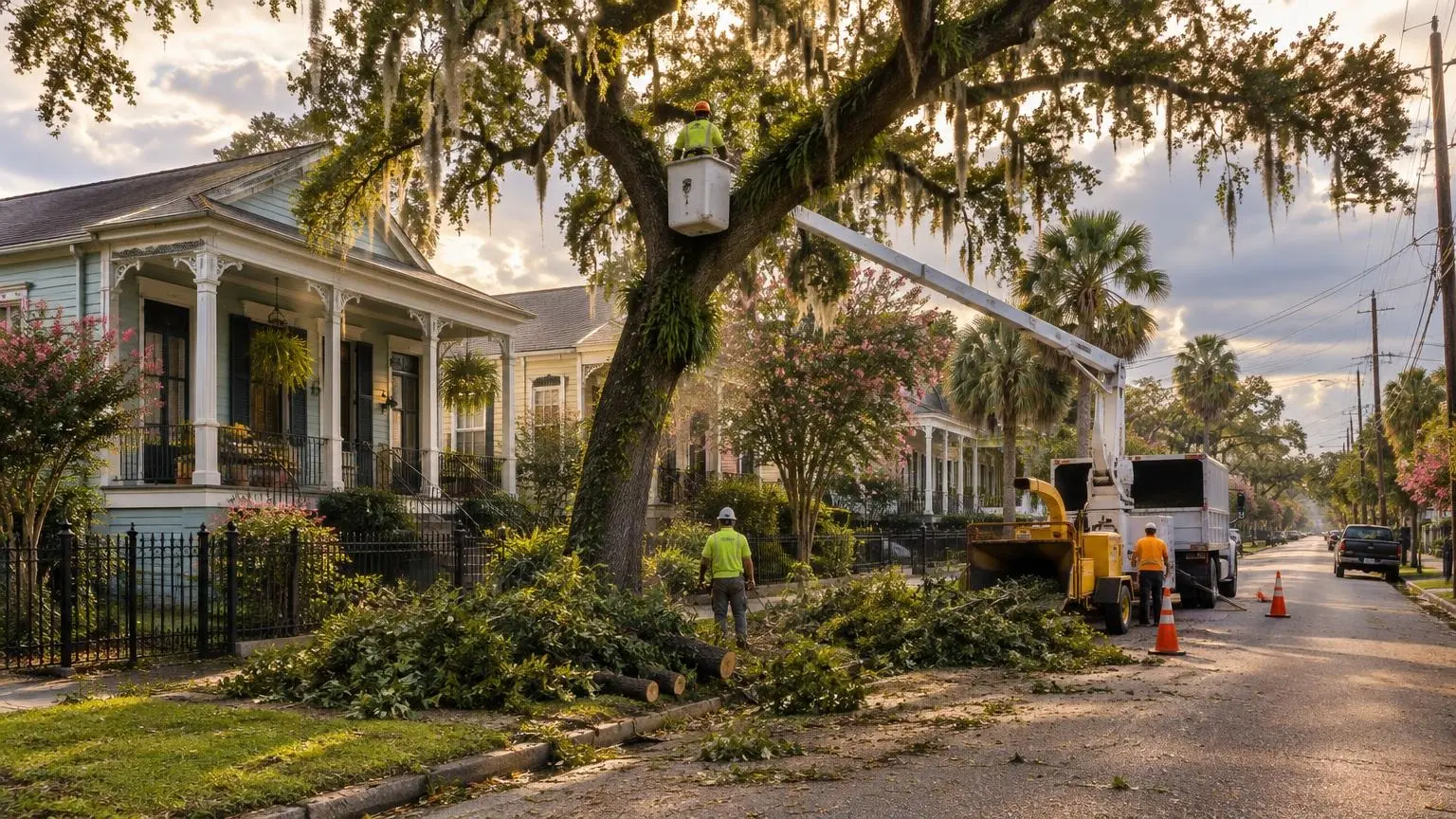
Sabal, date, fan and queen palms
Palm Tree Trimming in New Orleans, LA
Dead fronds and seed stalks off, healthy green crown left on, and no spike holes in the trunk.
- Free estimates, in person, for homes in New Orleans and nearby towns
- Itemized written price before any cutting
- Logs left or hauled, your call, agreed up front
Palms Need Less Cutting Than Most People Think
Palm tree trimming in New Orleans is mostly about restraint. Palms line neutral grounds and front yards across the city, from native sabal palms to tall Washingtonia fan palms and big Canary Island date palms, and most of them get cut too hard. A palm grows from a single bud at the top, has no way to replace a crown it loses, and uses its older fronds as a store of nutrients. Taking off more than the dead material usually does it no favors.
What should come off
UF/IFAS guidance is clear: removing fully dead fronds and flower or fruit stalks is never a problem, and removing living seed stalks does not appear to harm the palm. Those are the things that make a mess, drop fruit on cars and walks, and turn into storm debris. Under the ANSI standard for palm pruning, no fronds with tips above horizontal should be removed. Half-yellow lower fronds are often a sign of potassium deficiency, and UF/IFAS notes that cutting them off speeds the decline because the palm pulls nutrients from them. Those palms need fertilizer, not a haircut.
The hurricane cut
You see palms in the metro trimmed to a narrow tuft of fronds at the top, usually called a hurricane cut. It looks storm-ready, but UF/IFAS found that after the 2004 and 2005 hurricanes, palms with hurricane cuts were more likely to lose their crowns than palms with full ones. A full crown of green fronds bends and sheds wind; a stripped crown does not. Before hurricane season, take off what is dead and leave the green.
How palms should be climbed and cut
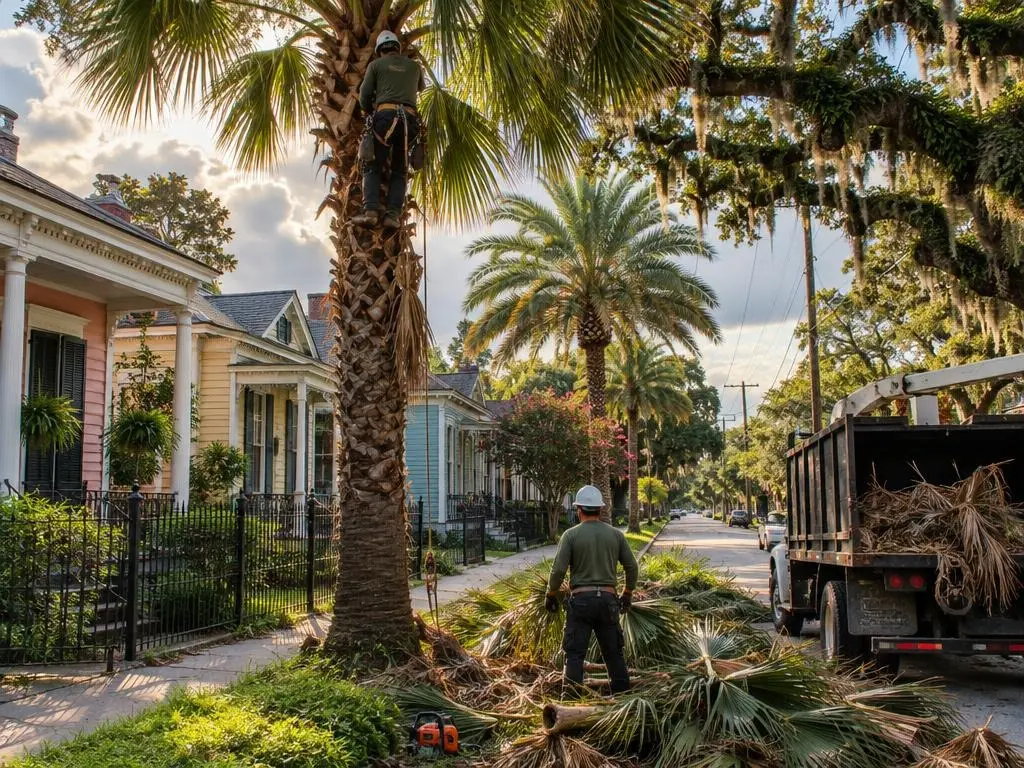
Climbing spikes leave holes in a palm trunk that never heal, so palms we trim are reached by lift, ladder or rope, not spikes. Fronds are cut close to the trunk without slicing into it, and boots, the old leaf bases, are only pulled if they come away easily. Disease matters too. UF/IFAS notes that Fusarium wilt in queen palms and Mexican fan palms can spread from palm to palm on pruning tools, and Canary Island date palms have their own form of the disease, so blades are cleaned between palms.
Palm removal
Palms that have lost their bud, are leaning badly or are badly diseased cannot recover, and removal is the only option. HomeGuide puts palm removal at about $200 to $1,200 nationally depending on height. Palm stumps are fibrous and are ground like other stumps.
What Palm Work Covers
Each palm is listed on the quote with what will and will not be cut.
Dead frond removal
Brown fronds cut close to the trunk, with green fronds left in place.
Seed and flower stalk removal
Stalks taken off to stop fruit drop on walks, cars and pools and cut down on seedlings.
Boot cleanup
Loose old leaf bases removed for a cleaner trunk where they come away without damage.
Tall palm work
Fan palms and date palms reached by lift or rope, never spikes.
Palm removal
Dead, leaning or diseased palms taken down and the stump ground if you choose.
Typical Palm Trimming Costs
| Job | Published range |
|---|---|
| Palm trimming, typical range (HomeGuide, national) | $100 to $650 |
| Palm up to 15 ft (HomeGuide) | $50 to $200 |
| Palm 15 to 30 ft (HomeGuide) | $75 to $400 |
| Palm 30 to 60 ft (HomeGuide) | $150 to $900 |
| Palm 60 to 80 ft (HomeGuide) | $250 to $1,100 |
| Palm removal (HomeGuide) | $200 to $1,200 |
Ranges from HomeGuide's palm tree trimming and tree removal cost guides. HomeGuide notes discounts for several palms on one visit, and palms with prickly or crowded fronds take longer. Your written estimate is the price.
How Palm Trimming Works
1. Identify the palms
Species, height, condition and any signs of nutrient deficiency or disease.
2. Agree on what comes off
Dead fronds and seed stalks are written on the quote; green fronds stay unless you agree otherwise.
3. Trim without spikes
Lift, ladder or rope access, with blades cleaned between palms.
4. Haul-off and cleanup
Fronds and stalks hauled away and seed debris raked from beds and walks.
Why Choose Us for Palm Tree Trimming
No hurricane cuts
We leave healthy green fronds on, as UF/IFAS research supports.
No spikes on living palms
Trunk wounds on palms never heal, so we do not make them.
Clean tools
Blades cleaned between palms to avoid spreading wilt disease.
Palm Tree Trimming Questions
How often should palms be trimmed in New Orleans?
HomeGuide puts most palms at one to two trims a year, depending on species and how fast they drop fronds and seed stalks. Native sabal palms often need less. Many homeowners have palms cleaned up in spring, before hurricane season.
Why are the lower fronds on my palm turning yellow?
Yellowing or half-dead older fronds are often a sign of potassium or another nutrient deficiency. UF/IFAS advises leaving them on and fertilizing, because cutting them speeds the decline.
Does a palm tree need to be trimmed before a hurricane?
Removing dead fronds and seed stalks before the season reduces flying debris. Cutting off healthy green fronds does not help; UF/IFAS found hurricane-cut palms lost their crowns more often in storms.
Can a palm with a broken or dead top be saved?
Usually not. A palm grows from a single bud at the top, and if that bud is dead the palm cannot grow a new one. It should be removed before it becomes a hazard.
How much does palm tree trimming cost?
HomeGuide's national figures run about $100 to $650 per palm, from $50 for a short palm to more than $1,000 for one over 80 feet. Several palms on one visit usually cost less each. We give a written price.
Palm Tree Trimming Service Areas
- Tree Service in New Orleans, LA
- Tree Service in Uptown, LA
- Tree Service in Lakeview, LA
- Tree Service in Gentilly, LA
- Tree Service in Algiers, LA
- Tree Service in New Orleans East, LA
- Tree Service in Metairie, LA
- Tree Service in Kenner, LA
- Tree Service in Harahan, LA
- Tree Service in River Ridge, LA
- Tree Service in Jefferson, LA
- Tree Service in Gretna, LA
- Tree Service in Terrytown, LA
- Tree Service in Harvey, LA
- Tree Service in Marrero, LA
- Tree Service in Westwego, LA
- Tree Service in Chalmette, LA
- Tree Service in Arabi, LA
- Tree Service in Meraux, LA
- Tree Service in Belle Chasse, LA
- Tree Service in Destrehan, LA
- Tree Service in Luling, LA
- Tree Service in Mandeville, LA
- Tree Service in Slidell, LA
Get a Palm Tree Trimming Estimate
Free estimate for one palm or a whole row. Call (504) 384-7694.